





Buying guide · Published

Cat Feeders for Two Cats: Choose by Feeding Need

Choose a feeder by shared meals, separate diets, tag access or wet food served by hand. Three exact-model approaches with clear limits.

The short answer

Choose by the job you need done.

Choose by whether both cats can share food and a feeding routine, need selective access, or eat wet food. PetSafe Simply Feed is an onboard timer for a compatible shared setup. One RFID adds dedicated-tag access to scheduled dry portions. Standard SureFeed controls access to wet or dry meals you serve yourself.

Exact scope · PFD00-14574 · PLAF301 · SureFeed Standard, non-Connect
A shortlist for different needs

Three approaches.
Choose the one that fits.

Shared food & scheduled portions

PetSafe Healthy Pet Simply Feed

PFD00-14574
Fits if
Both cats can share the food, schedule and accessible feeding station. Onboard programming supports up to 12 meals daily.
The tradeoff
It does not identify which cat eats. Bowl access and the shared routine must suit both cats.
Choose another approach if
Either cat needs a separate diet or the other cat regularly takes its portion.
[1][2]Read the full review
Scheduled dry food & tag access

PETLIBRO One RFID

PLAF301
Fits if
The target cat accepts its dedicated tag and needs scheduled dry food from a separate station. Kibble must fit the 2–15 mm specification.
The tradeoff
One dedicated tag per feeder; no implanted-chip reading. App/network setup adds dependencies.
Choose another approach if
The cat cannot wear its tag, needs wet food, or needs chip-based access.
[3]Read the full review
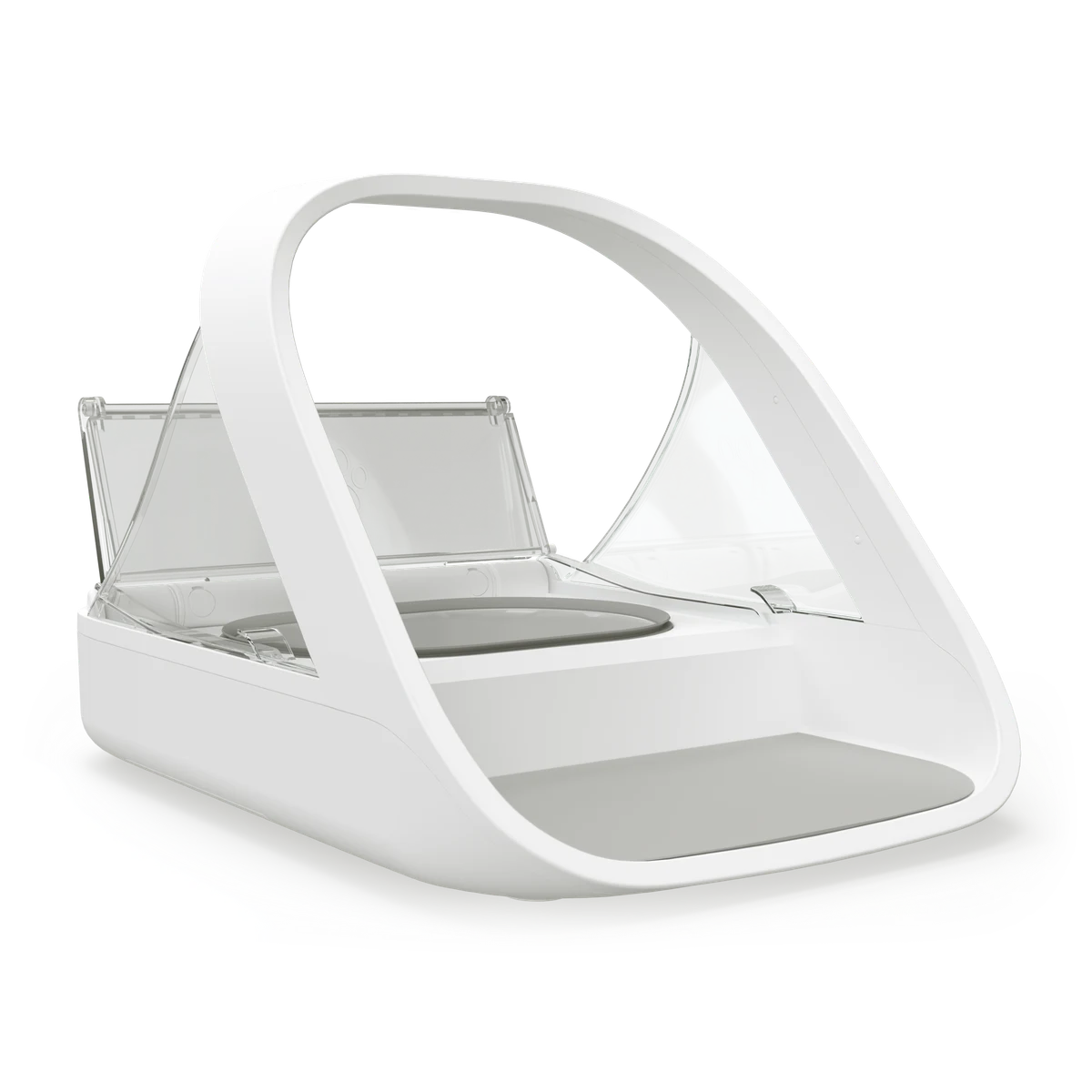
SureFeed Microchip Pet Feeder, standard model, shown at an angle with the lid open.
Manufacturer press photo · Sure Petcare.
Access to meals you serve

SureFeed Microchip Pet Feeder

Standard · non-Connect
Fits if
You serve portions yourself and want access for a compatible implanted chip or SureFlap collar tag. Wet or dry food is supported.
The tradeoff
You still fill and replace food. Authorized pets share the same bowl; identity count does not create separate portions.
Choose another approach if
You need programmed dispensing or scheduled chilled wet meals.
[4][5]Read the full review
At a glance

Match the choice to the need.

Household needOption to considerBoundary to check
Both cats can share one food/routineOption to considerPetSafe PFD00-14574Boundary to checkOpen access; does not reserve portions for a particular cat.[1][2]
Scheduled dry meals with selective tag accessOption to considerOne RFID PLAF301Boundary to checkDedicated tag and station; do not assume one unit handles two diets.[3]
Selective access to served wet/dry foodOption to considerSureFeed StandardBoundary to checkCompatible chip/tag; manual serving, no meal schedule.[4][5]
Before buying

A few useful questions.

Can one feeder stop one cat eating the other’s food?

A timer does not identify the eater. Selective access adds an identity check under documented conditions, but station placement and household behavior still matter.[3][5]

Does standard SureFeed schedule meals?

Standard SureFeed protects access to a meal you have served; it does not dispense food on a programmed schedule.[4][5]

Does One RFID read an implanted microchip?

PLAF301 uses its dedicated collar tag, one per feeder. PETLIBRO says implanted chips and other brands’ tags are not supported.[3]

Is a dual-bowl feeder automatically a better two-cat choice?

Bowl count alone does not provide separate identities, diets or schedules. Consider whether both cats can share food and access before choosing that layout.[1][3][5]

A closer look

Setup, limitations and related reading.

Choose by the problem you need to solve

They eat the same food and can share a station

An open-access timer may be enough when both cats can eat the same food, follow the same schedule, and reach the dispensing area without conflict. PetSafe says the Healthy Pet Simply Feed PFD00-14574 can be programmed on the unit, serves up to 12 meals a day, and supports dry or semi-moist food. Its product page lists portions from 1/8 to 4 cups and a 24-cup capacity. It does not recognize cats, so it cannot reserve a scheduled serving for one particular pet.

Consider it if: both cats can share the food and access. Skip it if: one cat needs a prescription or otherwise separate diet, or the other cat reliably takes that cat’s serving. The manufacturer’s feature list does not establish behavior in a particular multi-cat home.

One cat needs scheduled dry food and selective access

PETLIBRO One RFID PLAF301 is a tag-controlled scheduled feeder. The maker says it recognizes its dedicated collar tag, supports one tag per feeder, and dispenses dry food sized 2–15 mm. It does not read an implanted microchip or another brand’s tag. This can be a candidate when the target cat accepts a collar tag and the household can use a dedicated station; it is not evidence that one unit can serve two distinct diets or prevent every food theft.

Consider it if: scheduled dry portions and tag access match the routine. Skip it if: the cat cannot wear the tag, needs wet food, or the household needs chip-based access. App and Wi-Fi availability are part of this model’s setup; for offline needs, see Automatic Cat Feeders Without Wi-Fi.

The cat needs access control, but you serve meals manually

The standard SureFeed Microchip Pet Feeder is a selective-access bowl, not an automatic schedule feeder. Sure Petcare says it recognizes common implanted microchips or its RFID collar tag and can hold wet or dry food. Its manual describes authorizing pets to open the bowl. Up to 32 identities refers to authorized access identities; it does not turn the shared bowl into 32 individual diets or portion schedules. You still fill and replace food manually.

Consider it if: selective access matters more than automatic timing and the pet has a compatible chip or tag. Skip it if: you need timed dispensing, separate measured portions, or unattended chilled wet-food scheduling.

Questions to settle before buying
  1. Can both cats eat the same food, at the same time, from the same station?
  2. Does either cat need a separately measured diet or medication routine?
  3. Is the problem schedule, access, or both? A timer does not identify a cat; an access-controlled bowl is not necessarily a timer.
  4. Can each cat use the required tag or compatible microchip, and can the stations be placed so one cat cannot dominate both?
  5. Is the food dry, semi-moist, or wet? Verify the exact model’s food compatibility and portion range.
Evidence and related reading

Feature statements above come from manufacturer pages/manuals checked Oct 11, 2026: PetSafe product details, PetSafe setup guide, PETLIBRO One RFID, Sure Petcare standard feeder, and its user manual.

Related reading: PetSafe Healthy Pet Simply Feed review, PETLIBRO One RFID review, SureFeed Microchip Pet Feeder review, PETLIBRO One RFID vs SureFeed, and RFID vs. microchip feeders.

Sources & evidence 5 references
  1. PetSafe PFD00-14574 US listing
  2. Healthy Pet Simply Feed Set Up
  3. PETLIBRO One RFID PLAF301 US product page
  4. SureFeed standard US product page
  5. SureFeed standard manual