

Standard model · Non-Connect · Research-based
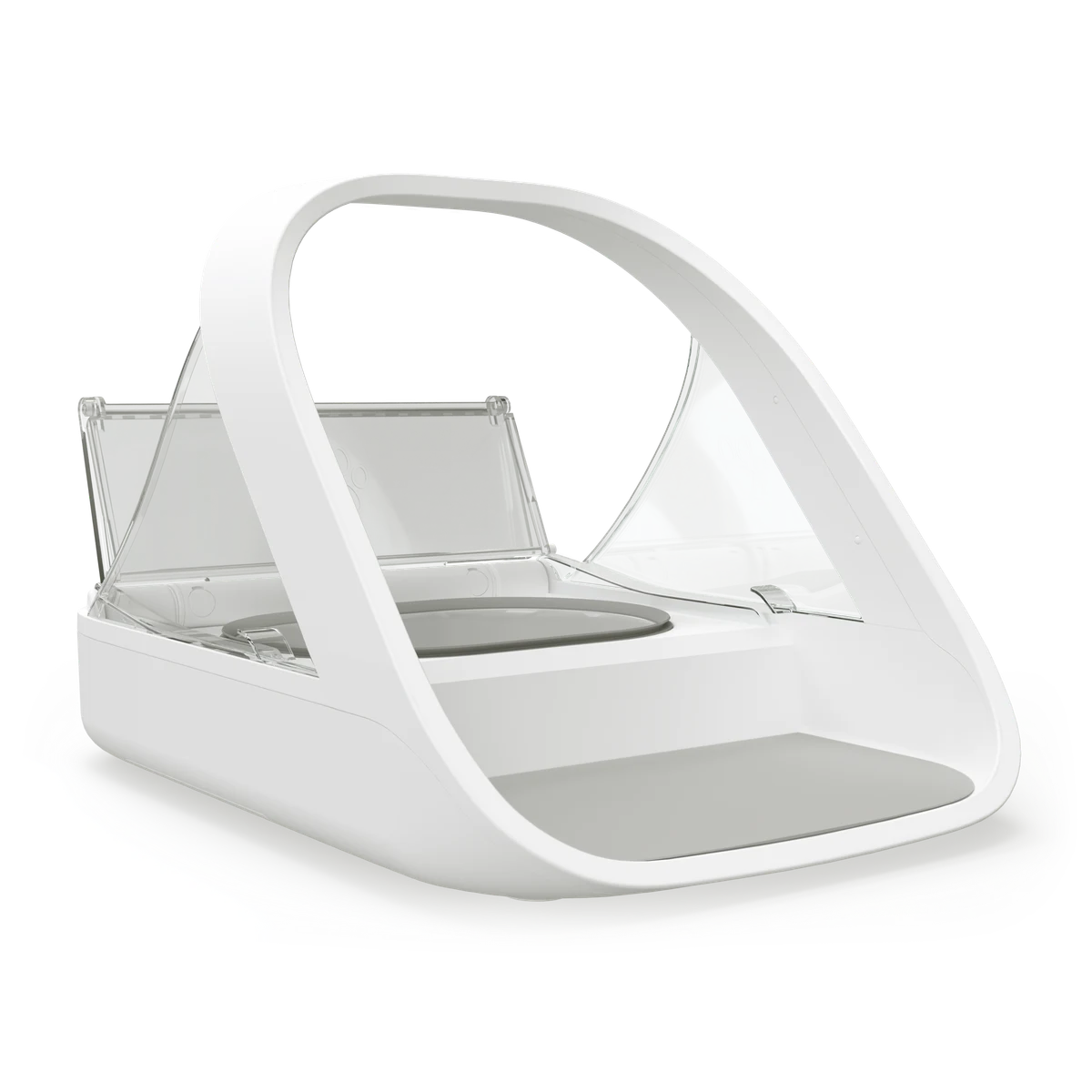
SureFeed Microchip Pet Feeder
Protect a meal you serve, with access by microchip or collar tag.

The shortlist decision.
Research-based · Not hands-on testedShortlist standard SureFeed for a grazer whose meal needs protection. It opens for a compatible chip or tag; you still serve and replace the food. Allow for training, hand washing and batteries, and watch for another pet entering an open bowl.
At a glance
- Power
- 4 alkaline C cells[2]




Daily use
What works
 What works
- Compatible implanted-chip access without a collar.
- Wet or dry served meals in one covered bowl.
- Local controls and flexible battery-powered placement.
What to weigh
 What to weigh
- Manual portions, refills and food replacement.
- A moving lid takes training; parts need hand washing.
- A determined pet may share an already open bowl.
Liz Coleman · Cats.com · October 2023
In one household with Floyd, Coleman found programming straightforward and the gradual training useful. Dry-food cleanup was simpler than removing wet-food residue from crevices. This several-week account helps frame the routine; it is not a theft-resistance test or PetDecider hands-on testing.
Read Liz Coleman’s review opens in a new tab
From everyday households
4 selected self-reported standard/base-model owners · Purchases and revisions unverified.
Appreciated
- Some selected owners described successful use after a learning curve.
- One described covered access for a wet-food grazer.
Look closely
- Two discussed extra cover or bowl costs.
- One described a cat still trying to butt in.
Sample and selection context
4 selected distinct explicit standard/base owners across 2 Reddit threads, 6 passages; 8 first-person SureFeed candidates screened in bounded passages. Non-representative, often accessorized; purchases/revisions unverified. Indexed date labels exist but exact timestamps were not confirmed; period left null. Connect and unresolved-variant accounts excluded.
These are selected external accounts, not aggregate satisfaction or PetDecider reader reviews.
Buying options
Confirm the exact model with the seller.
Chewy
Model and offer details
Standard Microchip Small Dog & Cat Feeder, 1 count. Live listing marked In Stock, free 1–3 day delivery and 365-day returns. Before tax; address/account and checkout conditions unverified.
Batteries and optional bowls or rear cover add to the feeder cost. No refrigeration or standard-model app.
No live price or stock feed. These links are not affiliate links.
Other feeding approaches
Compare productsMore detail
Research scope
Research-based review · October 9, 2026. Our assessment draws on Sure Petcare's standard-model documentation, an independent household review and selected first-person owner experiences.
Model specifications and included items
- Variant
- Standard Microchip Pet Feeder; not ConnectSource for Variant opens in a new tab
- Feeding job
- Access to a manually filled served bowlSource for Feeding job opens in a new tab
- Bowl / food
- 400 ml; wet or dry; no refrigerationSource for Bowl / food opens in a new tab
- Identification
- Compatible implanted chip or SureFlap RFID tag (one included)Source for Identification opens in a new tab
- Access memory
- Up to 32 identities; retained when batteries removedSource for Access memory opens in a new tab
- Power
- 4 × 1.5 V alkaline C cells; not included; no rechargeable designSource for Power opens in a new tab
- Battery estimate
- Manufacturer lists six months; household duration unverifiedSource for Battery estimate opens in a new tab
- Training
- Open introduction then three increasing lid-movement stagesSource for Training opens in a new tab
- Care
- Hand-wash supplied bowls/mat/lid; wipe body and clean hoop sensorsSource for Care opens in a new tab
- Feeder opening
- 8¼ inches wide × 6⅛ inches highSource for Feeder opening opens in a new tab
- Warranty
- Three years advertised on standard US listingSource for Warranty opens in a new tab
Our take
Our take
Standard SureFeed fits a household that needs selective access to a meal you serve yourself—especially a wet-food grazer sharing a home with a quicker eater. A compatible implanted chip can avoid a collar tag. You still portion, refill and replace the food; the feeder controls access rather than timing or measured dispensing.
Registered pets share the same served food, without separate portions or diets. Check chip recognition in the cat's eating position and how another pet approaches an already open bowl. A persistent food thief may need closer observation and additional protection. Standard US product page
Confirm standard, rather than Connect
Confirm standard, rather than Connect
This profile covers SureFeed Microchip Pet Feeder, standard non-Connect. The official US standard page links the manual used here. Its documented workflow uses buttons on the feeder and four C batteries. Connect's hub, app, weighing and intake-reporting features are outside this profile. The existing press asset is identified as MPF001; the current US product page does not explicitly establish a retail unit's revision number. Standard page and linked manual
The supplied set includes a full bowl, split bowl, mat and one RFID collar tag. Bowls and mats are gray in the standard listed package; optional replacements are separate purchases. Check a retailer's exact bundle rather than assuming stainless steel bowls or a rear cover are included. Package details
The listed opening is 8¼ inches wide by 6⅛ inches high; the complete feeder is 9 inches wide, 12⅝ inches deep and 7⅞ inches high. Use the opening measurement to assess your pet's approach, and leave room around the station for comfortable entry. These dimensions describe the product, not a guarantee that every large cat will use it comfortably. Official dimensions
| Decision detail | Documented answer |
|---|---|
| Feeding job | Selective access to a manually filled bowl |
| Food | Wet or dry; 400 ml served-bowl capacity |
| Identification | Compatible implanted chip or SureFlap RFID collar tag |
| Registered identities | Up to 32, all authorized to the same served food |
| Power | Four 1.5 V alkaline C batteries; not supplied |
| Training | Open-bowl introduction, then progressively more lid movement |
| Controls | Local Add Pet, Open/Close and Training buttons; lid-close delay slider |
Sources: US specifications and official manual, printed pages 3–10 and 14.
Setup and the first meals
Setup and the first meals
- Prepare the station. Wash the supplied bowl and mat before first use. Install four good-quality alkaline C cells with the indicated polarity; the manual says the feeder is not designed for rechargeables. Choose an indoor location with a comfortable approach and no trip hazard. If reading is unreliable near metallic or electrical appliances, move it away. Manual, printed pages 6–7 and 13
- Register the intended pet. Put food or treats in the bowl, keep other pets away and press Add Pet. The intended pet must put its head through the hoop so the presence sensors activate the chip reader; waving it in front does not register it. Repeat only for animals that should share this food. Identities remain stored when batteries are removed. Manual, printed page 8
Before buying for an implanted chip, use the manufacturer's chip-number compatibility checker. That checks supported identification, but it does not establish that a chip in a particular cat's body position will always read. If recognition fails, the manual suggests checking chip function and location with your veterinarian; the supplied collar tag is an alternative for an animal that can wear one. Compatibility checker · Manual troubleshooting, printed page 16
Training: useful, but access is open at first
Training: useful, but access is open at first
- Introduce the open bowl. Start training with no lid movement. For a particularly cautious pet, the manual describes introducing the bowl separately before bringing it closer to and eventually onto the feeder. Manual, printed pages 9–11
- Add movement gradually. Advance through the partial-closing stages only when the pet is comfortable. The manual recommends allowing a few days per step while acknowledging that some animals need longer. There is no promise that every cat adapts in a fixed number of days. Manual, printed pages 9–11
Early training leaves food accessible. In a home with separate diets, continue managing who eats which meal while the lid is open or partially open. For multiple feeders, the manual advises separating stations and progressing when all pets are comfortable. This is a transition you need to supervise, rather than immediate protected access on day one. Manual, printed page 12
Daily use and the limits of access control
Daily use and the limits of access control
Use Open/Close to replace the food, remove the dirty bowl, clear residue beneath it and insert a clean, filled bowl. Do not overfill: food or debris can prevent the lid moving freely or sealing. The manual calls for daily food replacement. Its seal is intended to cover the meal; it is not refrigeration, and the manual says not to put the feeder in a fridge or add ice packs underneath or inside it. Manual, printed pages 5 and 13
The lid-delay slider gives a useful tradeoff. A shorter delay can reduce the opportunity for another pet to get in after the authorized pet leaves; a longer one may help a pet nervous about movement. Delay adjustment does not solve every case of another animal putting its head or paw into an already open bowl. Watch the interaction you actually need the feeder to prevent. Manual, printed page 14
Sure Petcare offers a separate rear cover compatible with both standard and Connect feeders. It closes off a rear approach, rather than establishing complete exclusion from every direction. We would budget for it only after considering station placement and the other pet's behavior; no current US accessory price was verified. Official accessory compatibility
What an independent household review found
What an independent household review found
Liz Coleman, writing for Cats.com on October 24, 2023, evaluated standard SureFeed over several weeks with her cat Floyd, including programming and disassembly for cleaning. Programming the chip and tag was easy in her account; the graduated lid mode helped Floyd learn to put his head under the hoop. Her larger cat fit and was not bothered by the sound or movement. Those observations are household-specific, rather than a size or acceptance guarantee.
Coleman found dry-food cleanup straightforward but highlighted the difficulty of removing dried wet-food residue from crevices without getting water into the base. She also discussed side/rear access vulnerabilities, although the article mixes her own observations with other customer accounts on that point. Its affiliate buying links and older prices are not our current offer evidence. Coleman's review
Selected owner experiences
Selected owner experiences
We selected four distinct self-reported standard-model owners across two Reddit threads, accessed October 9, 2026. The selection is small, purposive and unequal to the One RFID sample. Ownership, purchases and hardware revisions are unverified.
- A base-model owner described more than a year using three feeders with rear covers and extra bowls. A persistent cat had gained access when the removable cover was inadvertently left unlocked; the owner otherwise reported successful exclusion. Base-model account
- A basic-model owner described a learning curve followed by successful use with two cats. Training account
- Two other explicitly basic-model contributors discussed rear covers and extra bowls as added costs. One reported keeping a wet-food grazer's meal covered; another liked cleaning the plastic bowls but still saw a cat try to butt in despite a rear cover. Accessory and access accounts
These reports help explain the daily routine and access checks. They do not establish representative satisfaction, food-storage safety, health outcomes or a reliability rate. Reports from Connect owners and negative accounts with unresolved standard/Connect identity were excluded from this standard-model summary.
Cleaning and batteries
Cleaning and batteries
- Remove and hand-wash the parts. Hand-wash the supplied bowls and mat to protect the integrated bowl seal. The removable lid is hand-wash only. Manual, printed pages 6 and 15
- Wipe the body and sensors. Use a damp cloth or appropriate household cleaning wipes; keep the four black sensor points on the hoop clean. Do not immerse the complete feeder or put it in a dishwasher. Manual, printed page 15
- Refit and lock the lid. Secure it correctly after cleaning. Manual, printed page 15
Wet-food suitability therefore comes with a practical maintenance burden: the bowl is removable, but food flung into the surrounding mechanism still needs careful surface cleaning. If your cat spreads food widely, this matters more than the nominal bowl volume. Coleman's cleaning observations support checking access to those crevices before deciding that the routine will be convenient. Independent cleaning account
The manufacturer lists six months of battery life, with a flashing low-battery light. Treat that as its estimate; the selected evidence does not establish a universal replacement interval or battery cost. It uses replaceable alkaline cells for normal operation, with no documented standard-model wall-power option. Keep compatible replacements available and attend to the warning rather than turning the six-month claim into a fixed schedule. Power specifications
Reasons it may fit and tradeoffs
Reasons it may fit and tradeoffs
- Implanted-chip access: useful for a cat that cannot comfortably wear a feeder tag, subject to compatibility and readable chip position.
- Wet and dry served meals: supports a routine built around manual portions and grazing access rather than hopper scheduling.
- Local controls and flexible placement: no app or hub is part of the standard documented workflow, and battery power avoids an outlet requirement.
- Patient introduction: graduated lid movement gives a documented training path, but food remains accessible during the early stages.
- Hands-on daily upkeep: you refill, replace food and clean the removable parts and surrounding crevices.
- Extra protection may cost more: a separate rear cover and preferred replacement bowls add to a multi-station setup, without guaranteeing that every food thief is excluded.
The benefit depends on the feeding job and the animal's behavior, not a numerical feature count.
Verified offer and ongoing costs
Verified offer and ongoing costs
On October 9, 2026, Chewy's standard-model, one-count listing displayed $199.00, marked In Stock, and advertised free 1–3 day delivery and free 365-day returns. This is listing-level information before tax and any account/address-specific conditions; checkout was not inspected. An older search result displayed $169.99 and out-of-stock wording, so it is not used as the current offer.
Budget separately for four alkaline C cells and any compatible rear cover, bowls or tags needed. The official accessories page confirms standard-feeder compatibility for rear covers and bowls, but directs US shoppers to retailers rather than giving a dependable current price. No annual dollar estimate is justified by the available battery and accessory inputs. Sure Petcare's standard US listing advertises a three-year warranty; seller return terms are a separate consideration. Warranty listing
Alternatives and verdict
Alternatives and verdict
Choose One RFID as the alternative when scheduled dry-food dispensing is the task you need automated and a dedicated collar tag is acceptable. Standard SureFeed is the relevant option when protecting a manually served meal matters more than dispensing it. The capacities measure different things: stored hopper food versus a meal in a bowl. See the comparison.
For pets that finish supervised meals promptly, separate-room feeding may solve the problem with less equipment. For a grazer needing continuing access, that same approach can require repeated supervision; this is where SureFeed's mechanism becomes more useful.
Our verdict: shortlist standard SureFeed for selective access to a meal you serve, especially when compatible implanted-chip use avoids a collar. Allow for training, hand washing, batteries and the possible rear cover. Neither the mechanism nor the selected reports guarantees exclusion of a determined animal, and registering multiple pets does not meter individual meals.
For a household decision sequence, see RFID vs. microchip cat feeders.
FAQs
FAQs
Will it dispense breakfast while I am asleep?
It opens access to food already in the bowl. It has no documented timed hopper-dispensing mechanism. Serve the meal yourself or choose a scheduled dispenser.
Can several cats use one feeder?
Up to 32 identities can be registered to the same bowl. That is shared access; different diets or separate portions require separate feeding arrangements.
Does it need Wi-Fi or a hub?
The standard model's documented setup and use are local. App/hub and weighing claims belong to the separate Connect product.
Can I use rechargeable C batteries or ice packs?
The manual specifies alkaline C cells and says it is not designed for rechargeables. It also says not to refrigerate the feeder or place ice packs underneath or inside it.
Does the rear cover make it theft-proof?
It is a compatible barrier for the rear of the feeder. Check side-by-side eating and entry while the lid is open as separate behaviors; the selected evidence does not justify a theft-proof claim.
Why will the lid not close completely?
The manual highlights overfilling and food debris under the lid or mechanism. Clear residue during refilling, check lid installation and consult model-specific support if the problem persists.
Are stainless-steel bowls included?
The standard listed package includes gray full and split bowls; stainless-steel replacements are offered separately. Verify the exact retailer bundle.
Research and offer checks are dated separately in the evidence records. Buying links in this draft are ordinary, non-affiliate URLs.