





 Confirm the exact model, bowl version and current instructions.
Wash and dry food bowls and feeding utensils after each use, following FDA guidance. Use the exact device instructions for disassembly and electrical surfaces. FreshFeed’s insert setting should match whether the steel inserts are installed; do not wash its electronic base as a removable bowl. FreshFeed guide · Cleaning instructions.
Refrigerated vs Ice-Pack Cat Feeders: What to Check
Compare cooling methods, serving exposure, portion counts, cleaning and backup power using exact FreshFeed and Polar examples.
Choose by the job you need done.
Compare the cooling method, the room conditions and what happens when a meal is served. A powered cooler, a frozen pack and a timer do different jobs. Compartment count is a portion-layout feature; it does not define a safe storage timetable.
Exact scope · US PFD00-18290 · current US PLAF109 stainless bowl · generic frozen-pack/timer mechanismsThree setups. Different jobs.
Powered cooling
An electric cooling system depends on its documented power supply, ventilation and room conditions. Check the food-temperature evidence rather than assuming refrigerator performance.[1][3][6][8]
A frozen pack
You prepare a pack in the freezer and follow the exact device’s loading and replacement instructions. The presence of a pack does not establish a fixed temperature or holding duration.[9][8]
A timer without cooling
A timer changes when food is accessible. Without a separate cooling mechanism, it does not refrigerate the portions or replace the food’s storage directions.[9][8]
Load → wait → serve.
- 1
Load
Prepare portions according to the food and device instructions. Check the real portion fit and the starting-food requirements. More compartments do not justify a longer storage period.[5][6][8]
- 2
Wait
Covered storage still depends on the cooling method, ventilation and room conditions. Check how power interruption affects cooling separately from the timer or tray.[3][5][6]
- 3
Serve
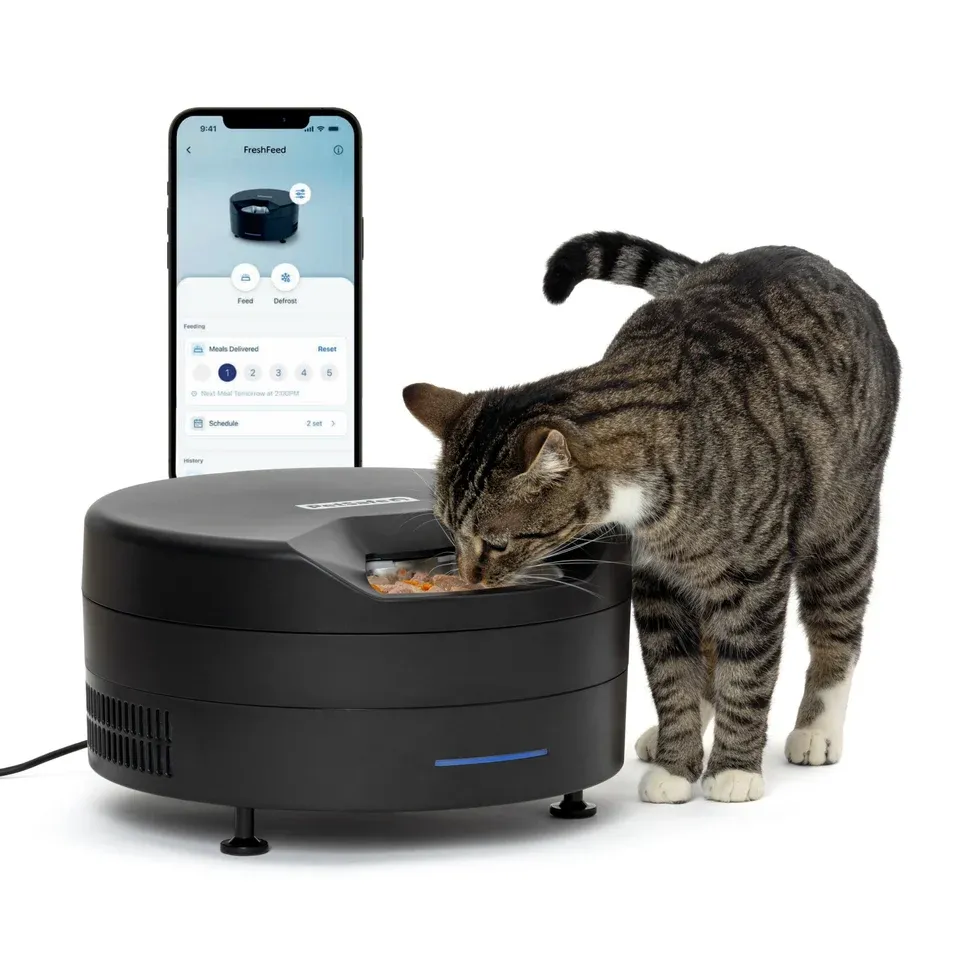
FreshFeed’s first compartment is immediately accessible; later portions follow the schedule. Exposed food is different from covered storage. FreshFeed defrosts before rotation; Polar’s FAQ says cooling pauses before service. Plan how to handle uneaten food.[5][6][8]
Two powered examples.
Choose the one that fits.
Six prepared meal slots
PetSafe FreshFeed
PFD00-18290 · US- Fits if
- You want six pre-portioned compartments and can follow the documented mains-power and cleaning routine.
- The tradeoff
- The plastic tray needs hand-washing. Steel-insert use is optional; confirm the selected package and unresolved volume statements.
- Choose another approach if
- You need selective pet identification or documented cooling through a power outage.
Three prepared meal slots
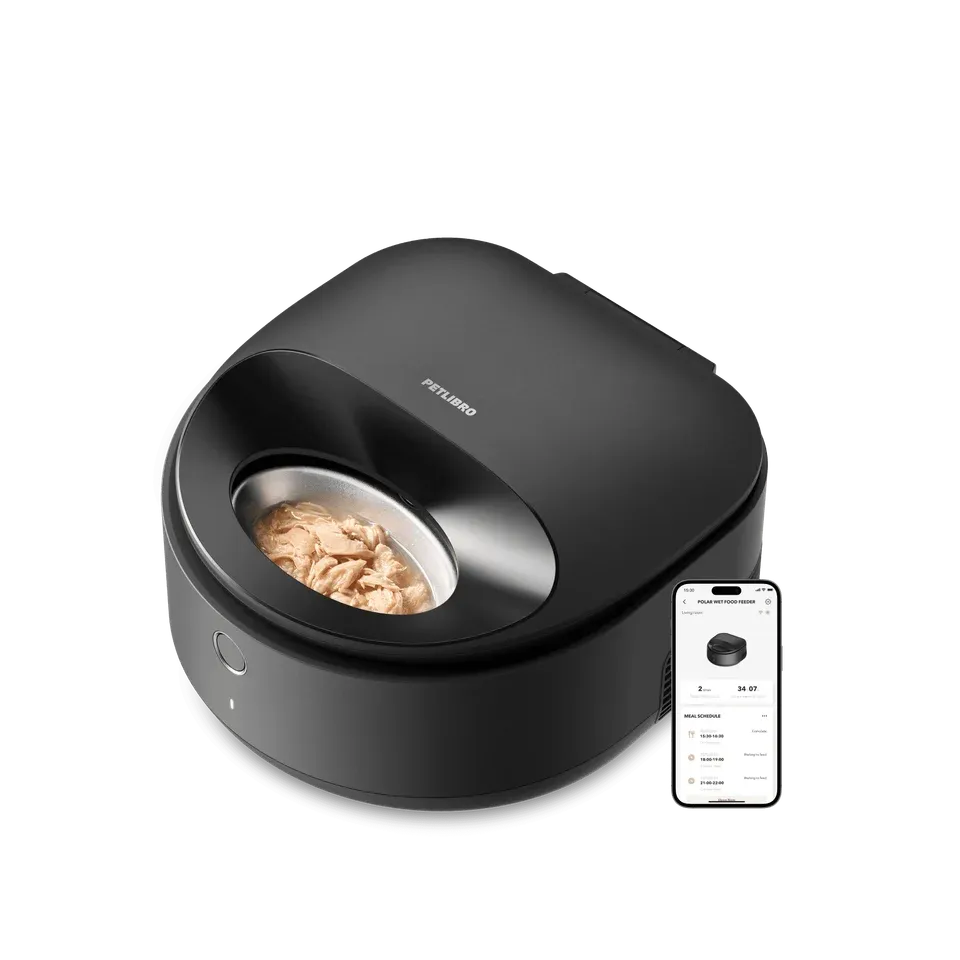
PETLIBRO Polar
PLAF109 · current US stainless bowl- Fits if
- Three compartments fit your routine and you can follow the current US stainless-bowl and commercial wet-food instructions.
- The tradeoff
- The maker’s cooling figure is a lab claim, and pre-serving cooling pauses. Its AA backup statements conflict and do not establish battery refrigeration.
- Choose another approach if
- You need more meal slots, raw-food compatibility or proof of cold-food protection during an outage.
Match the choice to the need.
| Household need | Option to consider | Boundary to check |
|---|---|---|
| Prepared portions | Option to considerFreshFeed: six compartments. Polar: three. | Boundary to checkCount the real portions and refill routine; meals are not a storage timetable.[5][6] |
| Cooling evidence | Option to considerFreshFeed: maker target 40°F when used as directed. Polar: maker lab around 54°F at 77°F ambient. | Boundary to checkDifferent stated conditions; no independent matched test or holding-time guarantee.[1][6][8] |
| Room and placement | Option to considerFreshFeed: indoors 60–85°F. Polar: maker’s optimal range 54–86°F. | Boundary to checkFollow the exact model’s airflow and power requirements.[3][6] |
| An outage | Option to considerFreshFeed: no documented backup. Polar: optional AA schedule backup. | Boundary to checkPolar’s 8H/12-hour statements conflict. Neither establishes cooling on backup power.[5][6] |
| Care and food | Option to considerFreshFeed: tray hand-wash; steel inserts top rack. Polar: current US stainless bowl has maker dishwasher permission. | Boundary to checkDo not transfer care from an older plastic Polar bowl. Food compatibility does not establish a storage duration.[4][6][8] |
| Different diets in two cats | Option to considerCooling and scheduling are separate from pet identification. | Boundary to checkNeither powered example identifies pets for selective access; observe meal sharing separately.[5][6] |
Check the complete routine.
- Confirm the exact model, bowl version and current instructions.
- Match the intended food to both the device instructions and the food label.
- Check room conditions, ventilation and the normal power supply.
- Fit the real portion within the documented compartment limit.
- Observe a scheduled serving while you are home, including access and leftovers.
- Plan cleaning and your response if power or cooling stops.
Watching a scheduled serving checks setup and access; it does not validate food-storage safety.
A few useful questions.
Is a refrigerated feeder the same as a refrigerator?
Do not assume so. FDA advises refrigerator settings of 40°F or below for unused canned/pouched pet food. A powered cooler does not by itself establish that every feeder portion meets those conditions.[8][1][6]
How long can wet food stay in an automatic feeder?
No single duration is established for every food and device condition. Follow the specific food’s storage directions and current device instructions; do not use a freshness slogan to extend them.[8][5][6]
Setup, limitations and related reading.
Cleaning between servings
Food compatibility is model-specific
PETLIBRO’s current US FAQ advises against raw food. PetSafe describes fresh/wet-food compatibility, but its guide requires the specific food’s storage and serving directions. Compatibility is not a safe holding-time guarantee, and the food’s starting conditions still matter. Polar FAQ · FreshFeed guide.
What a meaningful cooling test would measure
A matched test would need the same food, starting temperature, fill amount, room conditions, schedule and measurement locations. It would distinguish covered portions from food exposed for serving and record power interruption separately. This guide has no such independent results and assigns no cooling winner.
Sources & evidence 9 references
- FreshFeed PFD00-18290 US product
- FreshFeed exact-model support
- FreshFeed placement, room conditions and app setup
- FreshFeed cleaning instructions
- FreshFeed current user guide
- Polar PLAF109 current US stainless-bowl page and FAQ
- PLAF109 manual — model/setup cross-check only
- FDA pet-food storage and food-contact hygiene
- Closer Pets C500 UK — frozen-pack mechanism background only