


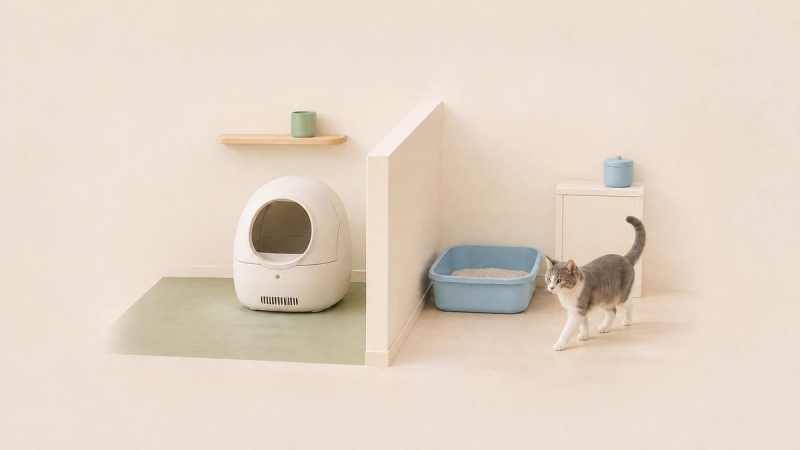

Quick answer: An automatic litter box may reduce how often you scoop, but it does not automatically replace every litter station in a multi-cat home. FelineVMA guidance gives a general starting point of one box per cat, plus one extra, and advises placing boxes in separate locations. For two cats, that means three locations to plan for; for three cats, four. Use those counts as a planning starting point, then assess each cat’s access and preferences.
Start with access, not the machine’s capacity claim
A common buyer question is whether one high-end automatic box can replace two regular trays. In a recent owner discussion, the poster was considering one unit for two cats partly because buying multiple automatic units felt expensive and family members found box cleaning difficult. Replies varied: some people described shared automatic boxes working for their cats; others recommended keeping a second box available. These accounts show the practical tradeoff, but they cannot establish what will work for your cats.
The FelineVMA’s caregiver guidance says the general rule is one litter box more than the number of cats. Its house-soiling guide adds that boxes should be separated: boxes placed close together may function as one resource, and one cat can block another’s access to a room or hallway. A self-cleaning cycle may remove waste from one unit, but it does not create another location or another route to a toilet.
| Cats in the home | General starting point | What to consider before buying |
|---|---|---|
| 2 | 3 litter boxes or stations | If you try one automatic unit, consider retaining other accessible boxes in separate locations, especially during the transition. |
| 3 | 4 litter boxes or stations | A capacity claim for one machine does not confirm that every cat can reach it comfortably or use it without being blocked. |
These counts translate the FelineVMA’s general cats-plus-one guidance into examples; they are not product-capacity ratings or guarantees. The same guidance emphasizes multiple and separated resources so each cat can reach them without being challenged. In a multi-level home, the house-soiling guide advises a box on each level. A single unit in a convenient room may still leave a cat without a comfortable option elsewhere.
Make placement part of the decision
Before ordering, look at where the current boxes are and whether each cat can reach them without passing a noisy appliance, a narrow doorway, or another cat who tends to wait nearby. The FelineVMA guide recommends quiet, private locations where a cat is not cornered or blocked from entry or exit. It also advises keeping boxes apart in different locations. Two trays side by side may not provide the same choice as two separated stations.
Then check the unit’s footprint, entry, height, waste-drawer access, and the path needed to remove the waste. The device still needs a suitable place and a caregiver who can empty and clean it. Manufacturer claims about how many cats a device can serve describe the product’s intended capacity; they do not override the general resource guidance or predict whether your cats will share it.
Keep a fallback while cats adjust
A gradual transition gives you a chance to see whether each cat uses the new unit. Follow the exact manufacturer’s setup and acclimation instructions. Keep familiar litter boxes available while the cats investigate and use the automatic unit; don’t remove all their usual options at once. The separate LR4 transition guide covers a gradual introduction for that specific product.
Watch for each cat’s access and use, not only whether the machine cycles. If a cat avoids the unit, another cat waits by its entrance, or one station appears to be the only usable option, keeping a conventional box in a separate place preserves choice.
Plan for times when the machine itself is unavailable, such as when you are emptying or deep-cleaning it, troubleshooting an alert, or dealing with a power interruption. If one unit is the only station, have another accessible option during that time. An automatic box still needs waste removal and periodic care; see the LR4 and MAX 3 cleaning and running-cost guide for model-specific routines and the litter compatibility guide for substrate restrictions.
Include the caregiver’s routine
Automation can shift the work from frequent scooping to emptying a drawer, handling supplies, and cleaning the device. If bending, lifting, or frequent scooping is difficult for a caregiver, compare how the bin opens, how much the removable parts weigh, and how often the unit needs hands-on cleaning. Ask another household member to check alerts or maintain a backup tray if needed. The machine may make one task easier, but it does not remove all litter care.
Browse the automatic litter-box reviews or the Litter-Robot 4 review for product-specific details. Compare the device’s entry, cleaning routine and upkeep with the places your cats already use.
Frequently asked questions
For two cats, should I keep three boxes if I buy one automatic unit?
FelineVMA guidance gives cats plus one as the general starting point. One automatic box does not by itself establish that the other stations are unnecessary. Keep accessible options and observe how each cat uses them.
Do the boxes need to be in different rooms?
They should be separated in different locations. The FelineVMA house-soiling guide says cats may treat boxes close together as one resource. Use your home layout to provide more than one accessible place.
Can a brand’s “multi-cat” rating tell me how many boxes to keep?
No. A product capacity claim is not the same as feline resource guidance. Check the exact unit’s instructions, but make the household plan around separated access and your cats’ use.
Does an automatic box remove the need for a backup tray?
It does not guarantee uninterrupted access. A regular box can remain available while cats adjust or when the automatic unit needs attention. Whether to keep one long term depends on your home and your cats’ observed use.
Sources checked November 3, 2026.