


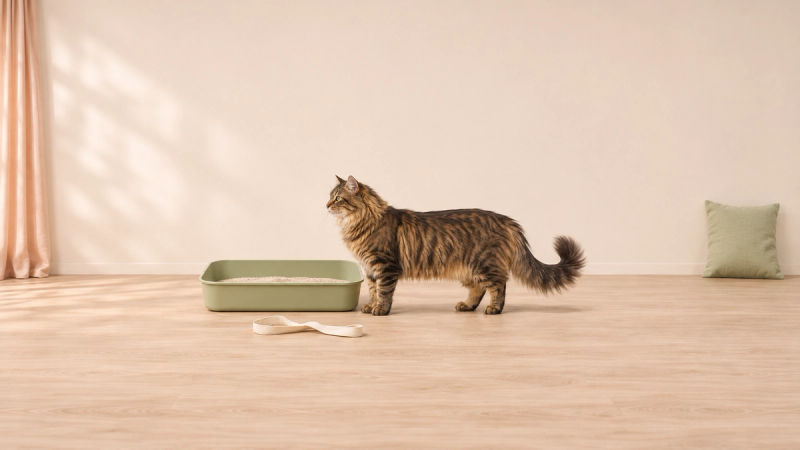

Measure your cat’s body length and the space available inside the box before buying. A listed weight range, large exterior or wide doorway cannot establish whether your cat has room to turn, dig and use the litter comfortably.
FelineVMA’s Cat Friendly Practice guide recommends a box about 1.5 times the cat’s length from nose to base of tail. Treat that as general box-size guidance. It does not certify a particular rotating globe or predict an individual cat’s acceptance. Cat Friendly Practice guide, page 15
Measure your cat and the box separately
Take a gentle measurement while your cat stands naturally; leave the tail out of the body-length figure. Keep the same unit throughout your worksheet. For example, a 20-inch body length × 1.5 = 30 inches. That is an illustrative planning reference, rather than a validated pass/fail test for an automatic box.
Measure the inside of a tray your cat already uses comfortably, too. It gives you a useful comparison when a product photograph makes the interior hard to judge. A current tray’s dimensions describe your setup; they do not establish a universal minimum.
| Worksheet item | Your measurement or answer | What it helps you check |
|---|---|---|
| Cat: nose to base of tail | ___ cm/in | Body length, excluding tail |
| Body length × 1.5 | ___ cm/in | General box-length reference |
| Current tray’s inside length × width | ___ × ___ cm/in | Existing room for turning and digging |
| Candidate’s usable litter-bed length × width | ___ × ___, or unknown | Space available at the normal fill level |
| Opening and interior headroom | ___; ___, or unknown | Entry space and room above the litter |
| Floor space and access around the device | ___ | Placement, approach and maintenance access |
Ask the maker how each interior measurement was taken. Was the box empty or filled to its marked level? Does the measurement include curved walls, space above the litter or an entrance recess? A missing measurement should stay unknown.
LR4 and MAX 3: what the published figures mean
Official measurements checked November 10, 2026:
| Measurement | Litter-Robot 4 | PETKIT PUROBOT MAX 3, P9906 listing |
|---|---|---|
| Entry opening | 15.75 in high × 15.75 in wide | Listed entry size: 267 × 273 mm (10.51 × 10.74 in) |
| Published interior | Globe: 19 in wide × 18 in deep × 15–17 in high, depending on litter level | Cylinder volume: 76 L; usable interior length, width and headroom unknown from the reviewed sources |
| Usable litter-bed rectangle at normal fill | Unknown; globe dimensions do not establish it | Unknown; volume does not establish it |
| Exterior placement information | 22 × 27 in footprint; 29.5 in exterior height | Confirm axis order and the manual’s measurement tolerance before planning a tight space |
Sources: Whisker’s LR4 FAQ, Whisker size comparison, PETKIT P9906 listing, and MAX 3 P9906/P9911 manual, page 26.
The LR4 globe figures describe its interior envelope. They do not mean that the whole litter surface is a flat 19-by-18-inch rectangle. Likewise, MAX 3’s 76 L does not reveal the length available for a long-bodied cat. These figures cannot establish which model offers more usable turning room.
PETKIT’s listing labels overall dimensions as W × D × H, while its joint manual gives an unlabelled axis order and allows a 1–3 cm measurement deviation. Ask the maker to confirm the exact unit’s footprint rather than treating a reordered specification as a new interior measurement.
PETKIT also lists 204 mm as entrance height, separately from the opening dimensions. Do not read that number as doorway clearance or interior headroom. PETKIT specifications
Check ordinary use before removing a familiar tray
If you try a box, retain an accessible conventional tray. Watch whether your cat enters voluntarily, turns without obvious crowding, digs and positions their body over the litter. Record hesitation, repeated awkward repositioning or waste outside the box for a discussion with the maker. Those observations do not identify a cause by themselves. New or repeated elimination outside the box merits veterinary advice; a dimension comparison cannot diagnose the cause.
For introduction steps, use our LR4 acceptance plan. Household access is a separate decision covered in the multi-cat guide; growing cats also need the kitten age and weight checks.
Questions owners ask
Does being under the weight limit mean my cat fits?
Weight alone gives you no body-length or turning-space measurement. Check the exact model’s operating restrictions separately from physical fit.
Can I compare cylinder volume to the 1.5-times guideline?
No direct conversion establishes usable length. Volume includes space in several directions; ask for measurements at the litter surface.
Which model should I choose for a long cat?
Use the worksheet and request the missing dimensions before choosing. Our LR4 review and MAX 3 review explain the wider ownership tradeoffs. The available measurements do not support a universal large-cat winner.