


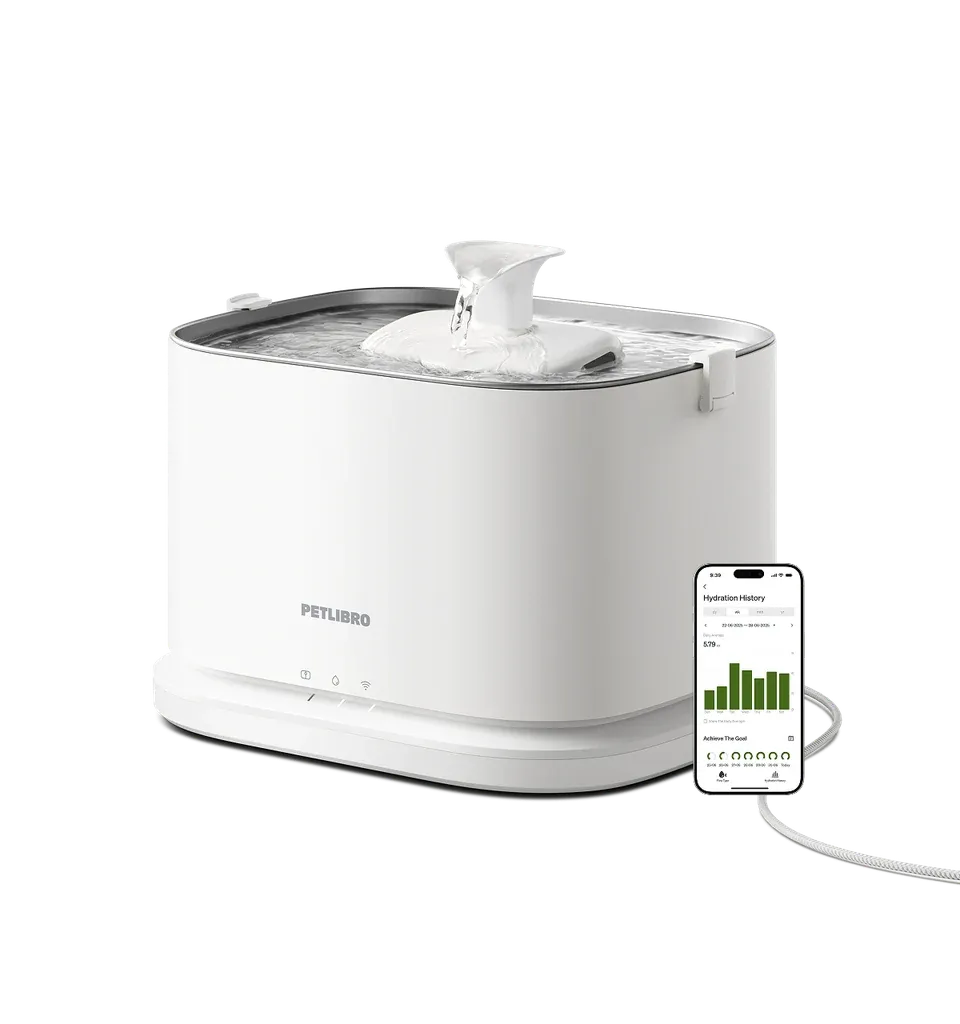
 Strengths
 Tradeoffs


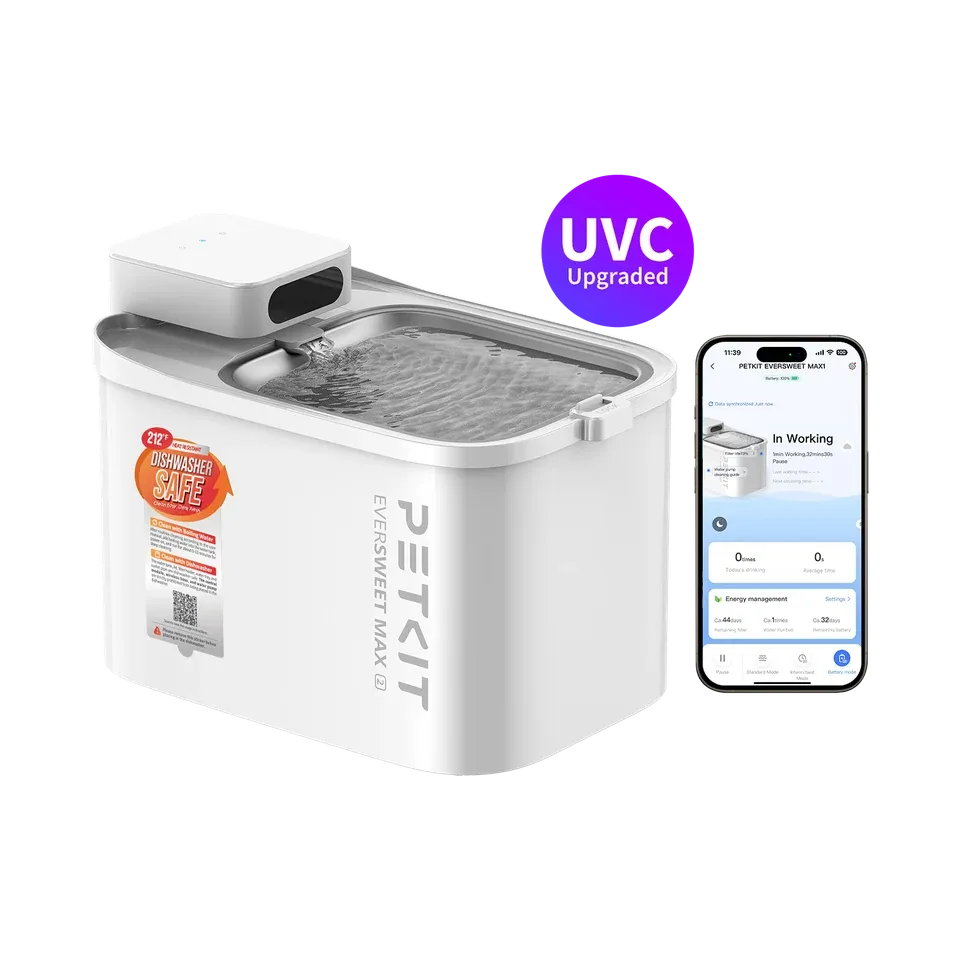
 PETKIT EverSweet Max 2 (UVC)
Placement away from an outlet: PETKIT, if the battery flow fits
P4116 is the conditional choice when the cat’s preferred location has no practical outlet. Its built-in battery lets you place the water station without a permanent power cable. The trade-off is a scheduled battery routine: the linked manual defaults to pumping for 25 seconds each hour, and says ordinary water-mode switching is unavailable on battery. More frequent pumping shortens runtime. PETKIT’s current listing promotes sensor mode and up to 83 days, while the linked manual does not describe that sensor behavior; get current-unit and firmware confirmation if sensor-triggered flow or a particular runtime matters. P4116 manual, pp. 8–9 and 13–14 · Current UVC listing
PLWF106 needs an outlet. It has no battery; continuous and timed operation are documented for the plug-in model. PETLIBRO plug-in presale answers · Flow-mode instructions
For the differences between PLWF106 and the original PLWF105, see the Dockstream generations guide.
Direct app connection: PETLIBRO
PLWF106 connects to home 2.4 or 5 GHz Wi-Fi. The P4116 manual describes local Bluetooth synchronization with the phone nearby. Remote PETKIT control and water-shortage notices require a supported PETKIT master device within eight metres, no blocked signal and current master firmware; the manual excludes Fresh Element P512 and P530. If you already own a supported PETKIT feeder or litter box, P4116 may fit your setup. If the fountain must connect directly over home Wi-Fi, PLWF106 has the simpler documented route. Neither route proves a particular alert will arrive on time. PLWF106 connection · P4116 manual, pp. 15–16
Dishwasher instructions: PETLIBRO
PLWF106 has the clearer dishwasher instructions. PETLIBRO permits the integrated stainless water tray and filter tray, excluding the filter lid, at temperatures below 194°F / 90°C and recommends a maximum 1–2 hour cycle. The base must not be rinsed or submerged; other parts are hand-wash only below 122°F / 50°C. The permitted trays cannot be separated. This is a conditional cleaning advantage if your machine’s cycle fits the limits, not a finding that the whole fountain is dishwasher-safe or faster to clean. PETLIBRO dishwasher instructions
P4116’s manual names six washable water parts and says to remove the base and control module first. Wipe those two electrical parts with a dry or slightly damp cloth; do not rinse or soak them. The current product page advertises dishwasher-safe materials, but the linked manual gives no component-specific dishwasher/cycle table. Confirm exact dishwasher permission before relying on that claim. P4116 manual, p. 17 · PETKIT’s current listing
Filter-change interval: PETKIT at its longest stated interval
PETLIBRO recommends changing PLWF106’s filter every two weeks for one pet, more often in multi-pet homes. Its related maintenance instructions also include rotor/shaft cleaning and replacement of the black foam filter on that cadence. PETKIT’s product FAQ recommends four weeks, while its RECT filter page says two to four weeks. At the four-week end, P4116 calls for fewer filter changes; shorten the interval if your household’s conditions require it. This cadence comparison does not make total upkeep or filter performance equivalent. PETLIBRO filter care · PETLIBRO plug-in maintenance · PETKIT RECT filter guidance
Continuous flowing water: PETLIBRO, or PETKIT while plugged in
Choose PLWF106 if continuous operation at an outlet is the required routine. P4116’s manual also documents continuous flow when plugged in, plus intermittent flow; on battery it defaults to its 25-second hourly routine. If you want a cordless fountain and continuous flow at the same time, the linked P4116 manual does not establish that combination. Its current product page’s sensor-mode claims remain unresolved against that manual revision. PLWF106 flow settings · P4116 manual